Just passing through
Salzburg
Easy to underestimate on arrival, and quietly generous once you give it a few more hours.
Salzburg is easy to underestimate on arrival. The baroque old town is immediately beautiful and immediately busy — but give the city a few more hours than you planned, cross the river, climb the ridge, and it quietly opens up beyond the postcard.
The lay of the land
How the city is built
The Salzach runs straight through Salzburg, with the old town on the left bank. Because the mountains are so close, the city doesn’t spread out evenly — it follows the river.
That shape is easy to read on foot. River, ridge, fortress: you always know roughly where you are. And the moment you cross the river or climb the Mönchsberg, the whole old town opens up in front of you, the mountains behind it.
A few neighbourhoods
How the city changes
A few areas give a sense of how Salzburg shifts as you move through it — a starting point, not the whole map.
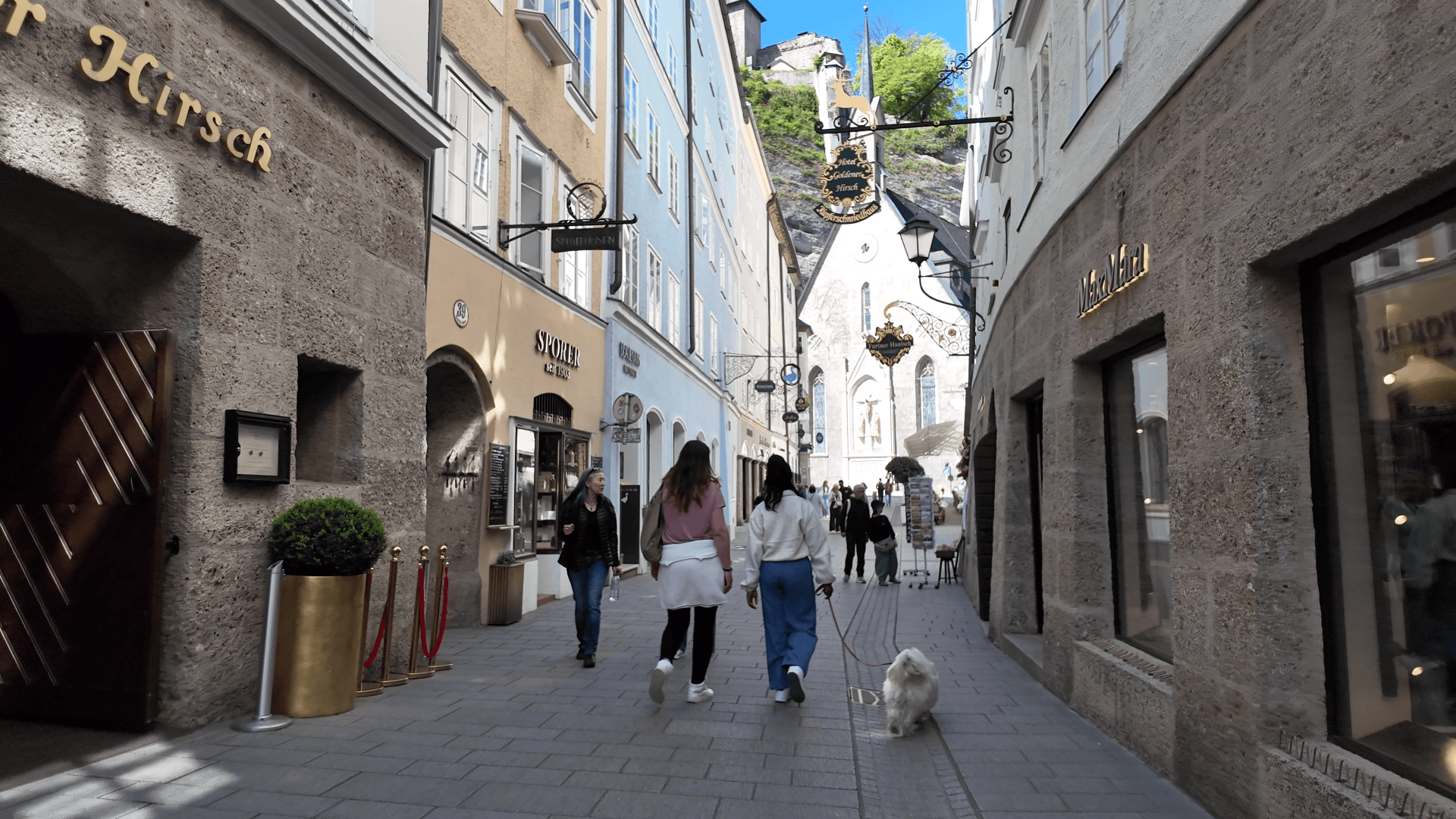
Altstadt — the baroque old town on the left bank. Pedestrian lanes, domed churches, the Festung Hohensalzburg above. The Salzburg most people come to see.
Mönchsberg — the ridge that rises directly from the left bank. There’s a lift, but also a path — and from up there you suddenly see how small and close everything is.
The right bank — Mirabellplatz, Linzergasse, and out towards the station. Less postcard, more everyday.
How it feels to walk
The pace
Walking in Salzburg is easy from the start. The old town is made for it and easy to read straight away — the city doesn’t ask much of you at the beginning. What happens when you keep walking is more interesting: leave the Altstadt, cross the river, and everything changes. The right bank is wider and more lived-in, and when you turn back towards the water the view opens — the old town on the left bank, the mountains behind it.
Most cities are flat; Salzburg isn’t. Climb the Mönchsberg and you’re no longer inside the city in the same way — you’re looking back at it. The one recurring friction is the bridges across the Salzach, which feel too narrow for the number of people using them, more noticeable the busier the day gets. And Getreidegasse, the main shopping street, can feel more like a corridor than a street when it’s full — though stepping off it is always worth the small act of will.
The quieter pleasures
What you’ll notice if you slow down
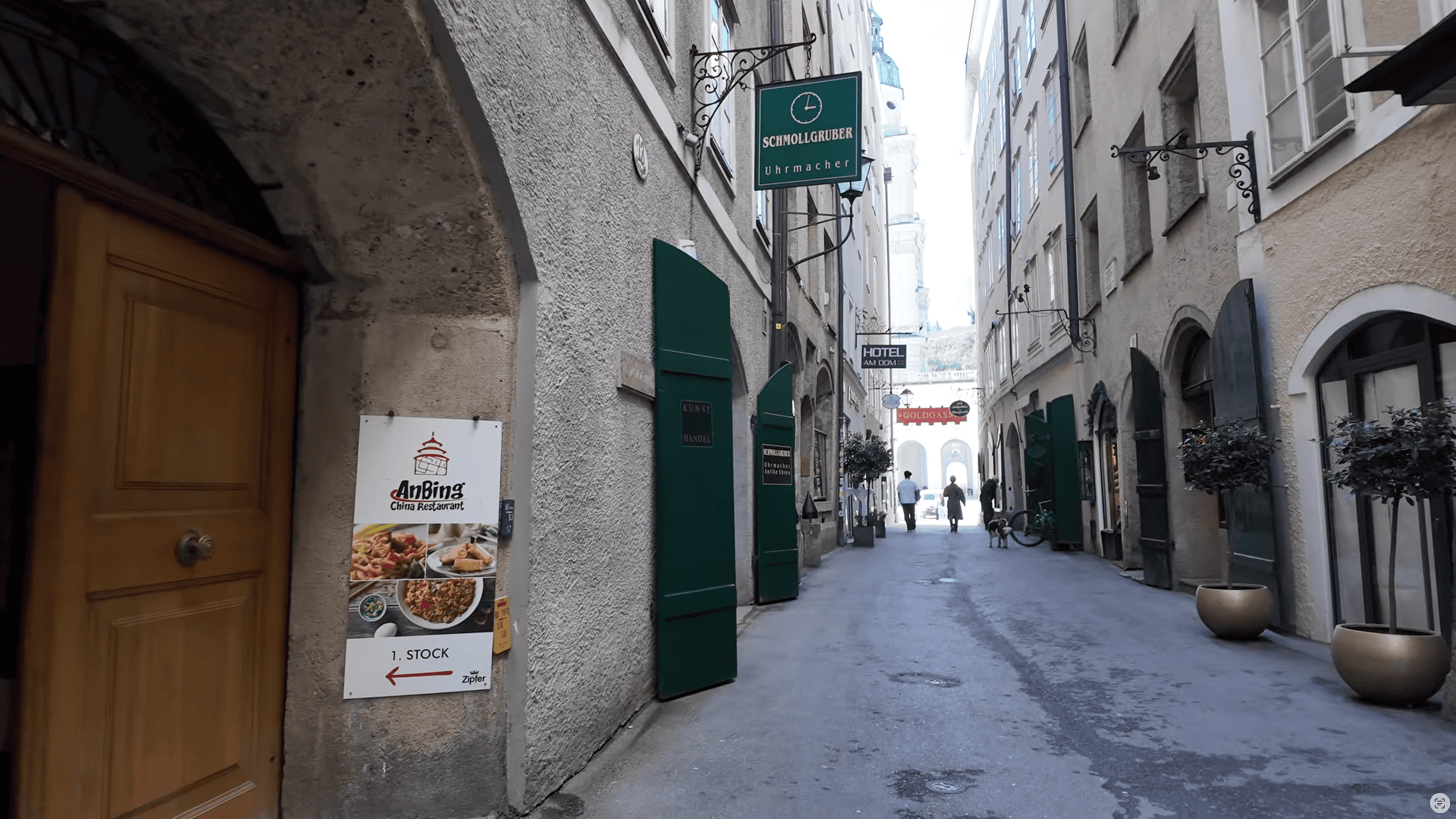
This is where Salzburg stands out. The pauses here don’t feel planned — you pass them, and then you stop. Along the water there’s a low stone wall where people sit, with cyclists and pedestrians passing in front of you. On the Mönchsberg you walk a path cut into the rock, the city spread below and the mountains beyond, and you stop because there’s nothing else to do.
Even inside the Altstadt the pauses appear unexpectedly — a courtyard off a side street, the fountain at Mozartplatz catching the afternoon light, the larger-than-expected space in front of the cathedral. You’ll feel it the moment the view from the ridge opens up. That’s what Salzburg does well: it puts small pauses in your way, and you don’t have to plan for them.

The Travel Without Chaos Index
How Salzburg scores
Three dimensions, each out of five — not a ranking, just an honest look at what the city feels like when you slow down.
The old town is immediately easy to move through; the right bank, the hillside paths and the quieter streets beyond the tourist routes are where walking here gets more interesting. The narrow bridges across the Salzach are a recurring friction point, worth knowing before you arrive.
Layered. The Altstadt is beautiful and busy, genuinely so — but the market on Mirabellplatz, Linzergasse and the streets near the station each add something. The longer you walk, the less Salzburg feels like only the old town.
Where Salzburg stands out. Waterfront walls, hillside paths, unexpected courtyards — you find them wherever you are in the city, not just in the obvious places.
On foot
A few places worth knowing
Not sights to tick off — a few suggestions for experiencing each side of Salzburg on foot. How it feels to walk, where the street life gathers, and where the city lets you stop. It’s how the video moves through the city.
Across the river around Linzer Gasse — still old and narrow, but with shop doors open and people moving at an everyday pace. Along the Salzach from the Staatsbrücke — the old town on one side, the hills closing in on the other, the river holding it together. And climbing towards Nonnberg — a few minutes and the streets narrow, the sounds fade, the city laid out behind you.
One street back from Getreidegasse, around Steingasse — the same stone underfoot, but quieter, with doorways people actually use. The Mirabellplatz market — the most everyday thing Salzburg has, stalls and people buying food in the morning. And Linzergasse across the river — old shops at a different pace, people stopping to speak to each other.
Mirabell Garden — paths, flowers and benches, the fortress above everything, a pause that feels built in. Higher up on the Kapuzinerberg — old town, river and hills in one clear frame, where you stop because the view settles something. And a bench by the Salzach — nothing famous, just the river putting a little distance between you and the city.
This is how the video walks Salzburg — the full route is in the film.
Want a local’s stories along the way? A guided walk through Salzburg’s old town →
What we recommend
Don’t miss these
You’ll come across plenty as you explore. These are the ones we recommend making time for.
The old town
Hohensalzburg Fortress — You’ll spend half your visit looking up at it, so go up. Skip the funicular — twenty minutes on foot, steep but easy, and the city unfolds beneath you step by step instead of all at once. Most people ride up, walk the terrace, and ride back down inside twenty minutes flat. Give it longer than that. The fortress is bigger than it looks from the street, with courtyards and passages that thin out fast once you’re past the first viewing platform, and the further in you go, the fewer people you’ll share it with. From the top, Salzburg finally clicks: a small city wedged into a valley, the river slicing straight through it, the hills doing exactly what they’ve always done — keeping the whole place contained. Skip the line at Hohensalzburg Fortress →
Salzburg Cathedral — Duck inside. You’re on Domplatz almost before you’ve registered arriving, and the scale hits you like a wall. Look straight up at the domes. Go early — the tour groups haven’t caught up yet.
Getreidegasse & Mozart’s Birthplace — Narrower than every photo makes it look, with wrought-iron guild signs worth craning your neck for. The birthplace sits about halfway down, easy to walk straight past — worth the five minutes if you know to look.
Across the river
Mirabell Palace & Gardens — Don’t just snap the photo and move on. Everyone stops at the same spot — hedges in front, fortress framed behind — gets the shot, and leaves within five minutes. That’s a mistake. The gardens go back further than they first appear, in tiers, past the famous view and into sections most visitors never reach: a rose garden, a small maze, benches nobody’s sitting on. It empties out fast the further you go, and the fortress keeps reappearing between the trees at angles the postcard shot never shows you. Free to enter, open long hours, and worth building into your route rather than treating as a five-minute stop.
The Mozart Residence — Quieter than the birthplace, and better for it. This is where the family actually lived, a short walk from Mirabell — fold it into the same loop and you’ll barely notice the detour.
DomQuartier — The indoor route linking the palace and the cathedral. Perfect when the weather turns, and it drops you above the Dom for a view the square never gives you.
Just outside town
Hellbrunn Palace — Go for the gardens even if the fountains don’t interest you. Though they will. Built in the 1600s by an archbishop with a taste for practical jokes, the trick fountains are rigged into benches, tables, even a stone grotto — sit in the wrong seat and you’ll find out fast. Guides still trigger them on the hour, so time your visit around a tour group if you want to stay dry, or don’t, and treat it as part of the experience. Past the fountains the gardens themselves are worth slowing down for: shaded paths, a small zoo, a hillside folly with a view back toward the city. It’s a proper half-afternoon if you let it be, not a twenty-minute detour.
Nonnberg Abbey — A working convent above the old town. The climb is the reward as much as the abbey — steeper, quieter, a different city entirely from up there.
The Sound of Music locations — Scattered across the city and the lakes beyond it. Walk the Mirabell route and you’ll stumble into several without meaning to.
The fortress, Hellbrunn and the Mozart houses need a ticket. Everything else — the squares, the gardens, the lanes — you’ll just walk into.
Short on time? Do two: the fortress for the view, Mirabell for the pause. Everything else you’ll probably stumble into anyway.
Where to stay
Three hotels, all worth the stay
Where you stay shapes how a city feels. For Salzburg we stayed in three hotels worth recommending — one near the station, one inside an Altstadt lane, one across the water — each a different version of the city.
Salzburg is the middle stop on the trip from Munich down to the Adriatic — the full route is coming soon.