Just passing through
Tirana
Flat, sun-bleached and full of traffic — and one of the most alive street cultures in Europe.
Tirana sits in a flat valley ringed by mountains, and the city wears its energy right on the surface. Skanderbeg Square opens out at the centre, a boulevard runs south from it, and cafés spill onto nearly every pavement in between. The traffic never really stops — but neither does the street life, and that trade is what makes Tirana worth walking.
The lay of the land
How the city is built
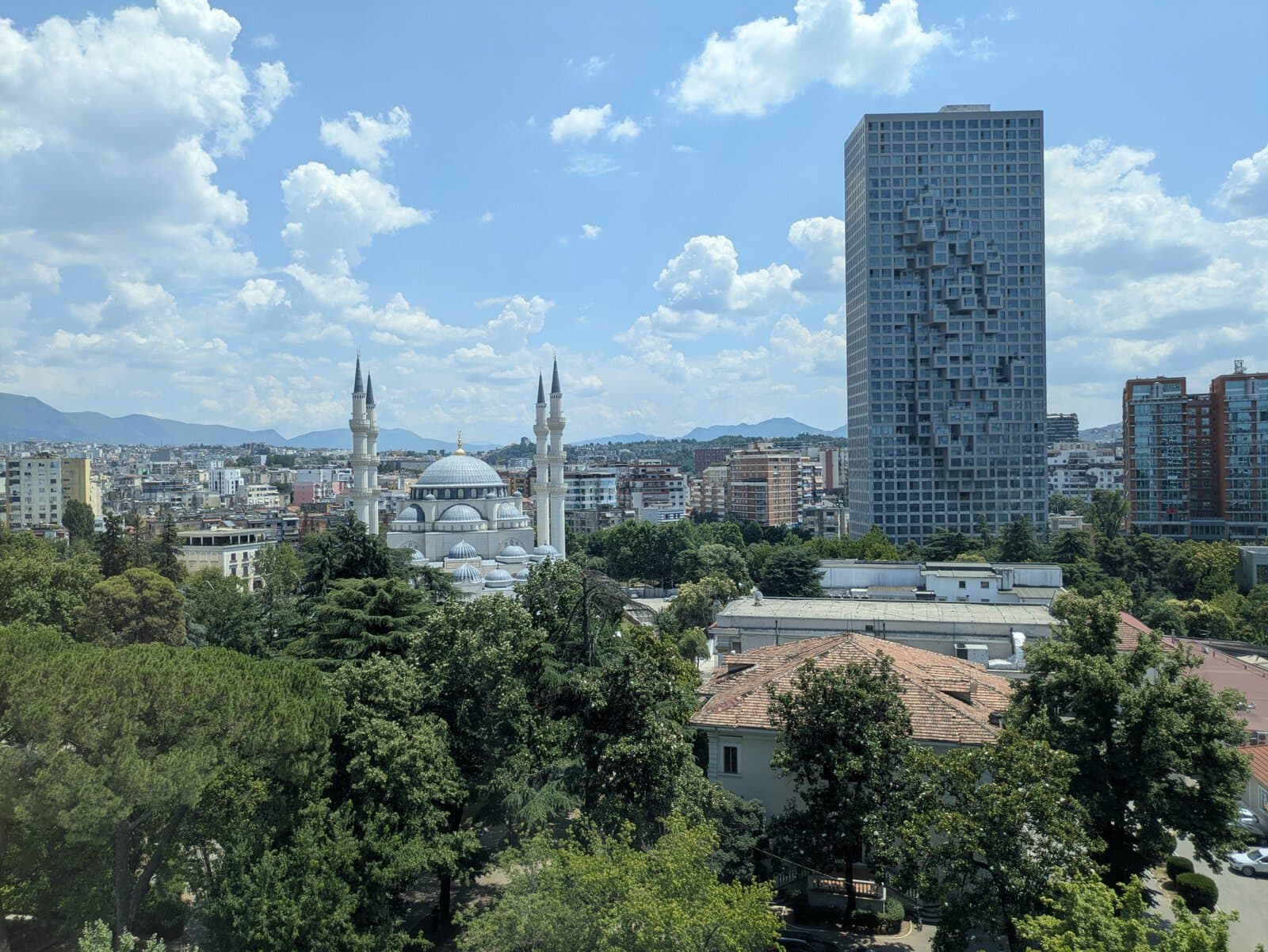
The city is flat, and everything starts from one place: Skanderbeg Square, a vast open space at the centre with a long boulevard running south from it. The rest of Tirana folds out from there — not in neat rings, but in pockets that feel distinct once you’re standing in them.
South of the square, the lake park — Parku i Liqenit të Tiranës — is the city at its quietest, trees and paths and water. And Blloku, once closed off to almost everyone under the old regime, is now the part of the city where Tirana relaxes: cafés, small shops, people meeting the city rather than passing through it.
A few neighbourhoods
How the city changes
A few areas give a sense of how Tirana shifts as you move through it — you recognise them not by name, but by how they feel. A starting point, not the whole map.
Skanderbeg Square — open, paved, monumental. Where the city presents itself. The place everything else starts from.
Parku i Liqenit të Tiranës — the lake park, south of the centre. Trees, paths, water. The city at its quietest.
Blloku — once closed to almost everyone. Now full of cafés and people. The part of the city where Tirana relaxes.
How it feels to walk
The pace
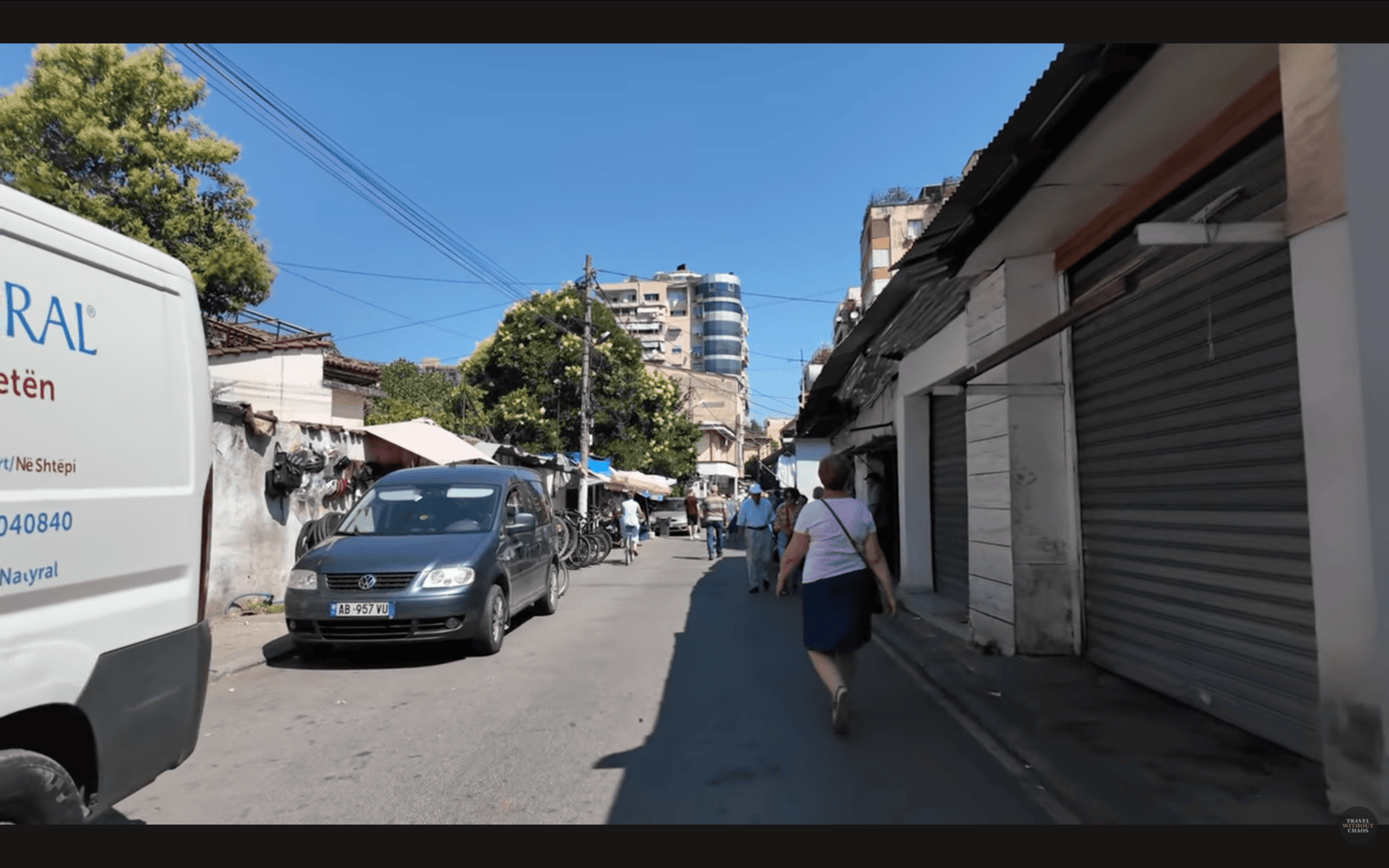
Tirana is flat, and that helps — the centre is compact, and most of what you want to see sits within a short walk of the square. But most of the time here, walking means moving around cars: the ones driving past, and the ones parked where the pavement should be. You pick your line, step out and back in, wait for a gap, keep going. It’s not unpleasant, but it’s never quite effortless either.
Every so often the ground clears. Skanderbeg Square is one of the biggest car-free surfaces you’ll cross in any European city — open pavement, room, the mountains at the end of it. The boulevard south of the square does the same thing — wide and straight, running south with space you don’t have to negotiate for. Those are the moments the city lets you breathe. Then the next street pulls you back in — and that trade, traffic against the odd wide-open stretch, is what walking Tirana is like.
The quieter pleasures
What you’ll notice if you slow down
In Tirana, the pause is rarely separate from everything else. A café table on a side street, a chair pulled out onto the pavement, an espresso that comes with no particular expectation you’ll finish it quickly — that’s what passing through the city looks like here. The Grand Park, wrapped around its lake just south of the centre, is the kind of green space that exists for the people who live here rather than for visitors passing through; the traffic noise drops back the moment you walk in. Rinia Park, smaller and more central, is one you fall into on the way somewhere else, without really deciding to stop.
But the pause Tirana does best is the one that doesn’t look like a pause at all: the table that was already there, the coffee that took a little longer than expected, the street that gave you somewhere to sit before you even looked for it.
The Travel Without Chaos Index
How Tirana scores
Three dimensions, each out of five — not a ranking, just an honest look at what the city feels like when you slow down.
Mixed. There’s real walking here — the boulevard, Rruga e Kavajës, stretches of the centre — but traffic is never far away. Step off the main routes and you’re negotiating with cars more than moving past them.
Outstanding, and it’s the reason to come. Cafés fill from morning until night, Blloku doesn’t let up, and the evening square draws half the city out for a walk with nowhere particular to go.
Solid, and café-led rather than park-led. The Grand Park and Rinia Park both earn a visit, but the real pause in Tirana is the nearest café table — always close, always enough.
On foot
A few places worth knowing
Not sights to tick off — a few suggestions for experiencing each side of Tirana on foot. How it feels to walk, where the street life gathers, and where the city lets you stop. It’s how the video moves through the city.
Follow the main boulevard south towards Mother Teresa Square — wide pavements, an open road, and the mountains ahead of you the whole time. Or walk west from Skanderbeg Square along Rruga e Kavajës, down to where it meets the Lana — a longer, more everyday side of the city, away from the monuments. If you’d rather not commit to a direction at all, the streets around Skanderbeg Square and Pazari i Ri reward wandering without a route.
Blloku — café streets that are full from breakfast until late, and easy to settle into. The area around Pazari i Ri — stalls, coffee, and the city doing its shopping for the day. And Skanderbeg Square in the early evening, when half the city seems to come out for a slow walk with nowhere particular to go.
A café table anywhere in Blloku — the pause finds you before you look for it. The Grand Park and the lake, south of the centre — ten minutes from the square, and a slower world. And Rinia Park — small, central, easy to drift into without really meaning to.
This is how the video walks Tirana — the full route is in the film.
What we recommend
Don’t miss these
You’ll come across plenty as you explore. These are the ones we recommend making time for.
The centre
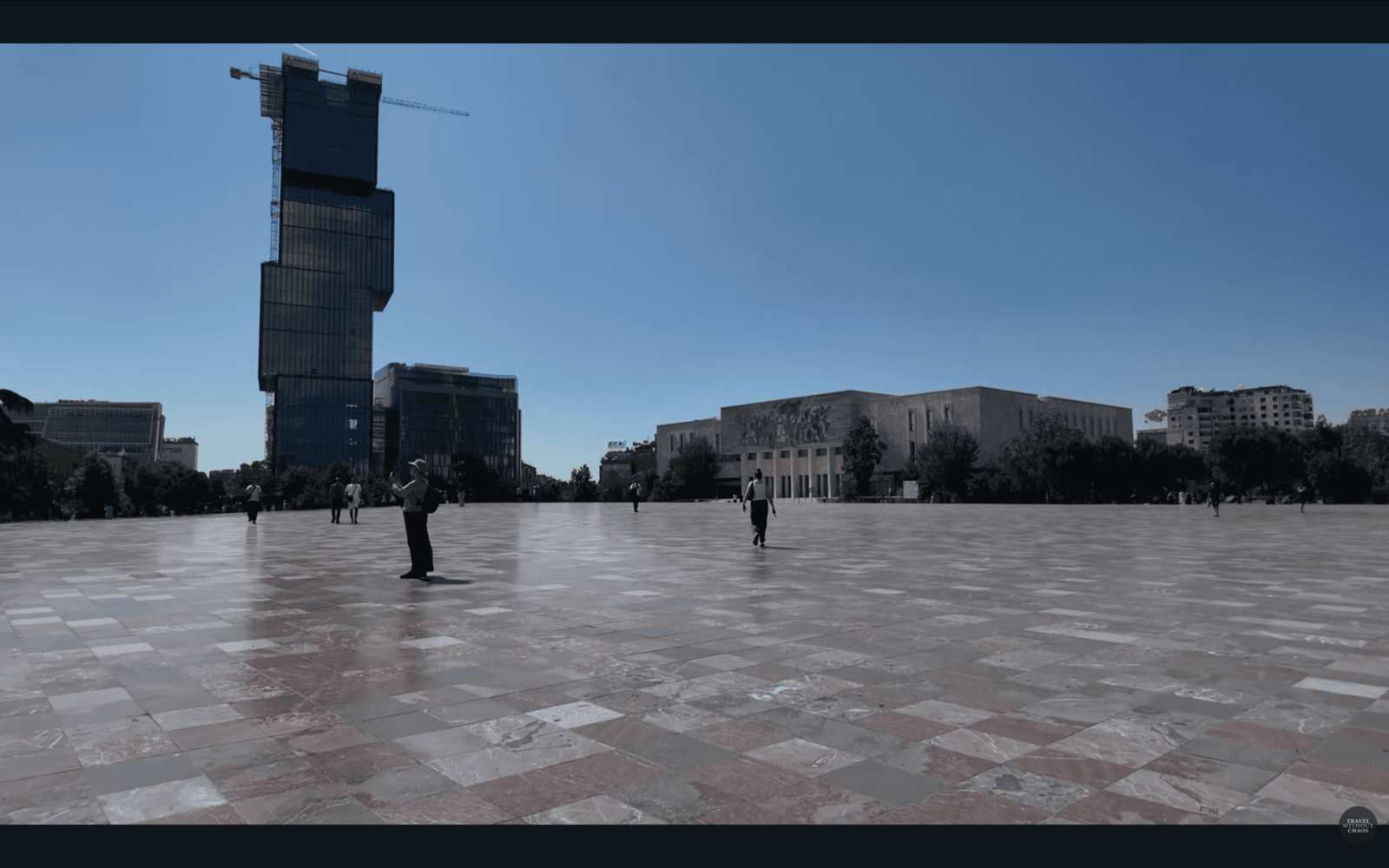
Skanderbeg Square — This is the square Tirana organises itself around — one of the largest car-free surfaces in any European capital, ringed by the National History Museum, the Et’hem Bey Mosque and the old clock tower, with Dajti mountain sitting at the end of the boulevard. It was a Stalinist parade ground for decades before its 2017 redesign opened the whole space to pedestrians. Come at different times and it reads completely differently: near-empty and vast at midday heat, filling with families and slow walkers as the evening cools down. It’s also simply where you’ll end up first — every route in the city eventually leads back to it.
Et’hem Bey Mosque — An 18th-century mosque right on the square, its interior painted with rare frescoes of trees, waterfalls and bridges rather than the usual geometric patterns.
Kulla e Sahatit (Clock Tower) — The 19th-century clock tower beside the mosque, small enough to miss and worth the short climb for the view over the square.
South of the square
Piramida (Pyramid of Tirana) — Built in 1988 as a museum to communist dictator Enver Hoxha, left to decay for decades afterwards, and reopened in 2022 as a public building — terraces, workshops and a rooftop you can climb for one of the better views in the city. It’s one of the more direct places in Tirana where you can feel the country’s history sitting right under the surface: nobody tore it down, they just gave it back to the city instead. There’s no ticket for the exterior and roof terraces — it’s simply open, day or night, and worth building into a walk rather than a special trip.
House of Leaves — A former surveillance-equipment clinic turned museum on the communist-era secret police, unsettling in a way most museums aren’t.
Grand Park & the Artificial Lake — The city’s biggest green space, wrapped around a lake, popular with locals rather than built for visitors.
Just outside town
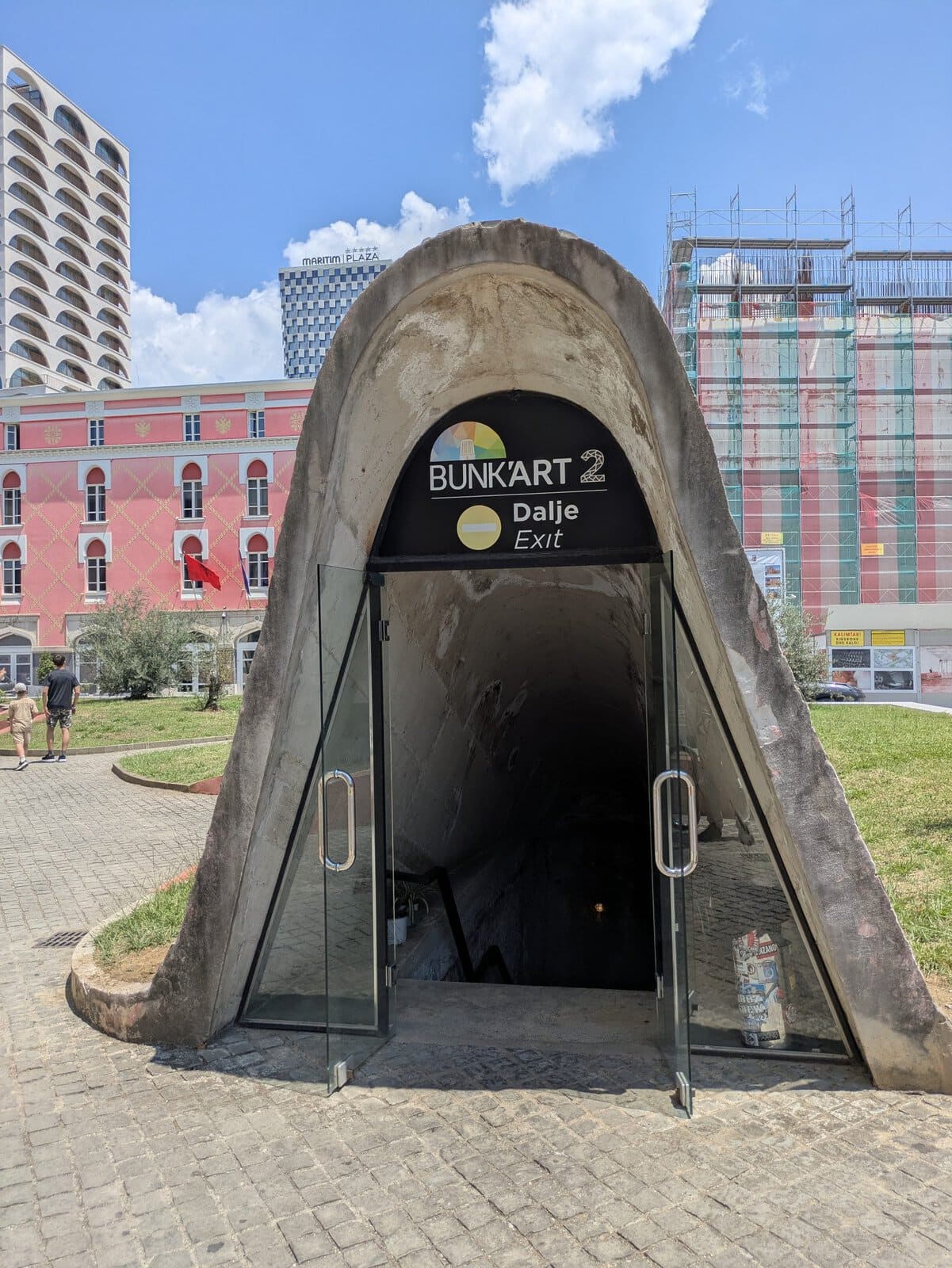
Bunk’Art 1 & Bunk’Art 2 — Two Cold War bunkers turned museums, telling the story of Albania’s decades of isolation from two angles. Bunk’Art 1 is the big one: a five-storey nuclear bunker built for Enver Hoxha and Albania’s top leadership, hidden inside a hillside on the edge of the city and only opened to the public in 2014 — over 100 rooms, still fitted with period furniture, gas filtration systems and assembly halls. It takes a taxi or a short drive to reach, not a walk from the centre. Bunk’Art 2, right in the centre near Skanderbeg Square, is smaller and more contained, built around the machinery of the secret police and the Ministry of Interior. Between the two, it’s the single most unusual few hours you can spend in Tirana, and worth planning half a day around. A guided tour of Bunk’Art 1 →
Dajti Ekspres — The cable car up Dajti mountain, fifteen minutes above the haze and traffic to pine forest, hiking trails and a view over the whole city and the plain beyond it.
Krujë — A hillside town half an hour north, an Ottoman-era bazaar leading up to a hilltop castle and the museum dedicated to national hero Skanderbeg — worth the half-day trip.
Bunk’Art 1, Bunk’Art 2, the Dajti Ekspres cable car, the House of Leaves and Krujë’s museum need a ticket. Everything else — the squares, the mosque, the park, the Pyramid’s terraces — you’ll just walk into.
Short on time? Do two: Skanderbeg Square for the city’s centre of gravity, Bunk’Art 1 for something genuinely different. Everything else you’ll probably stumble into anyway.