Just passing through
Trieste
Grand as Vienna, unmistakably Italian — a port city at the very edge of the country.
Trieste sits at the very edge of Italy, and it shows you both things at once. The buildings are grand and neoclassical — the kind you’d expect in Vienna or Budapest — and for a moment, walking through, that’s exactly where you feel you are. Then a vespa cuts past, and you know exactly where you are.
The lay of the land
How the city is built
Trieste works on two levels. Along the water runs the long waterfront, open to the sea — no shelter, no shade, just the full exposure. Behind it lies the grid: wide streets with good sightlines, laid out in the eighteenth century, with a canal cutting through towards the water.
And above it all, the hill. Cathedral and castle look out over the roofs and the port, and the higher you climb, the greener and quieter it gets. Waterfront, grid, hill — start with those three and Trieste is easy to get to know.
A few neighbourhoods
How the city changes
A few areas give a sense of how Trieste shifts as you move through it — you recognise them not by name, but by how they feel. A starting point, not the whole map.
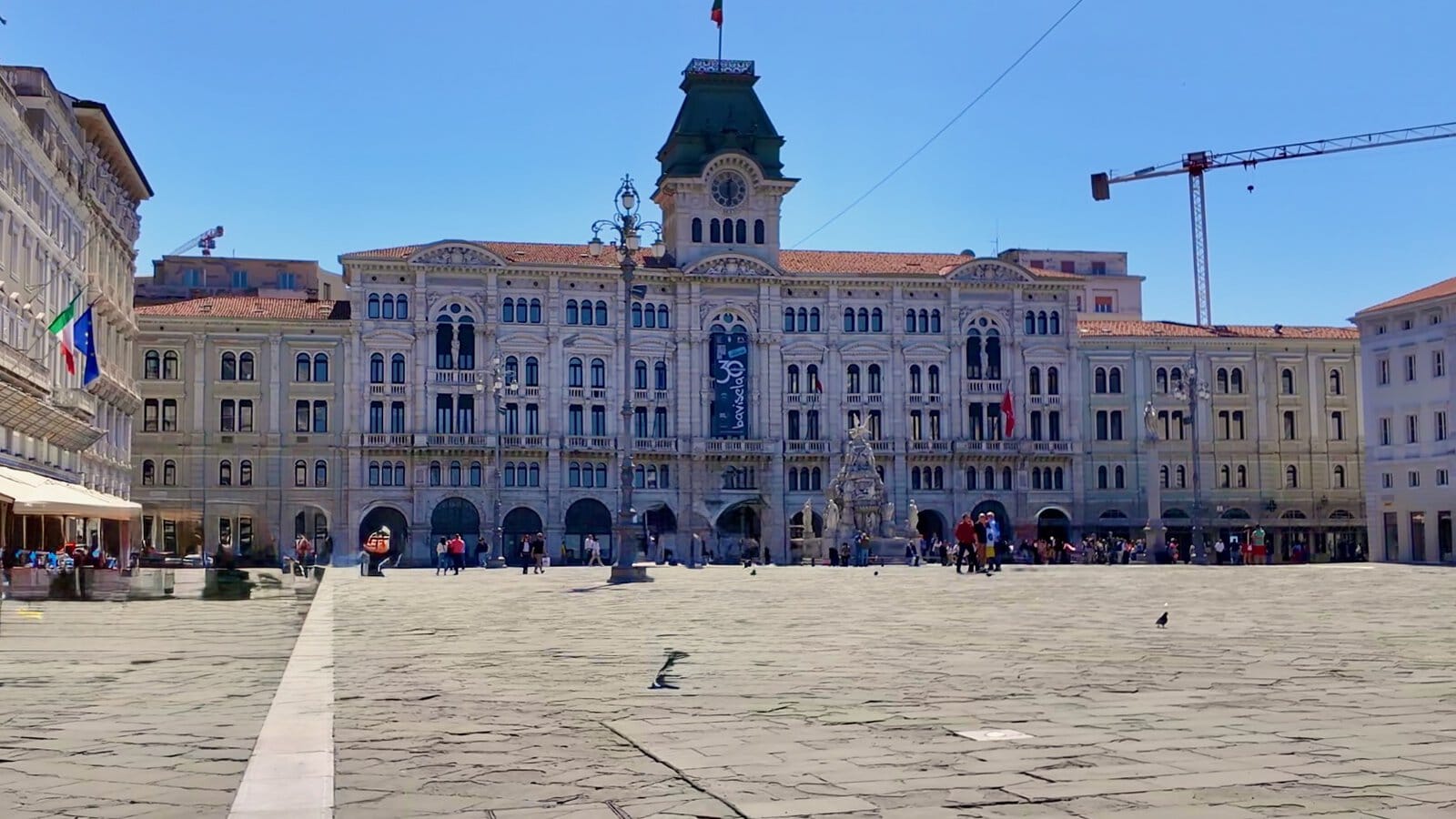
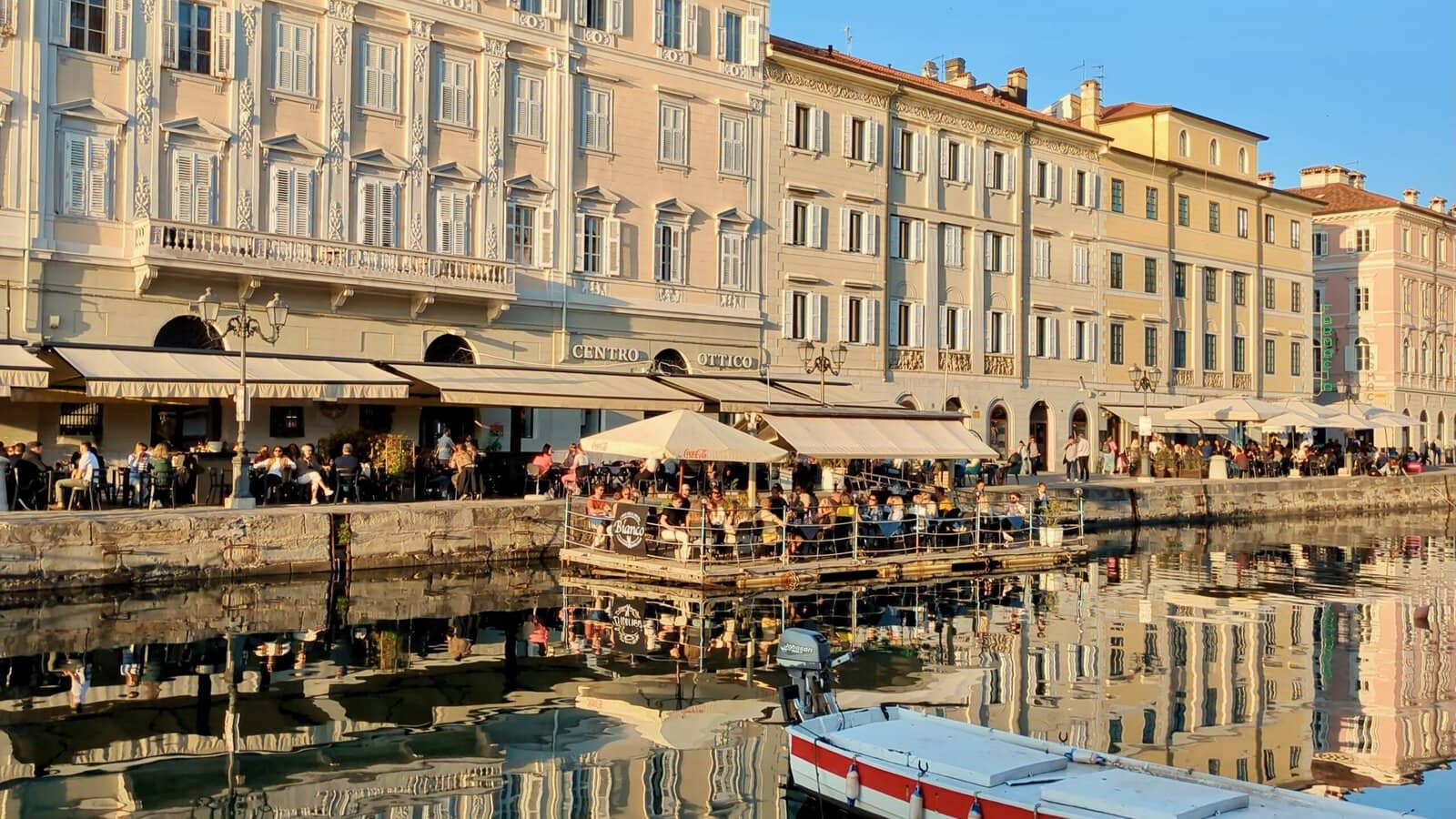
Borgo Teresiano — the eighteenth-century grid, with the Canal Grande cutting through it towards the water. Wide streets, grand façades, cafés along the quayside.
Piazza Unità d’Italia — a huge square opening straight towards the sea. Imposing on three sides, open on the fourth. There’s a busy road between the square and the water — but the pull between them is still there.
Colle di San Giusto — the hill. Cathedral and castle with a view of the city, and streets that grow quieter the higher you go.
How it feels to walk
Getting Around Trieste on Foot
In the grid, walking is easy — wide streets, good sightlines, and you know roughly where you are most of the time. The logic changes when you step off the main streets: the lanes narrow, the blocks shrink, and you lose your bearings. Somehow that’s fine, because around the next corner there’s usually something worth finding.
One thing to know: the infrastructure is modest, and it shows in places. Some edges are there — a crossing that takes some navigating, a pavement that ends before you expect it to. But honestly, that’s also part of what makes Trieste interesting to walk in. It isn’t polished, and it doesn’t need to be.
The quieter pleasures
Where Trieste Lets You Pause
Trieste gives you not just a few big pauses but a lot of small ones. Walking through the city you pass small parks between buildings and benches along the way, and there are café chairs outside almost every bar and hole in the wall, facing the street. No one seems in a hurry to move you on — you can just sit and let the time pass.
Move up the hill and it goes green and quiet, and with the view you can see exactly why someone built a port here. Trieste is not a big city, population-wise. But it feels grand — and it gives you plenty of reasons to pause.
The Travel Without Chaos Index
How Trieste scores
Three dimensions, each out of five — not a ranking, just an honest look at what the city feels like when you slow down.
High, for the most part. The waterfront and the grid are easy to move through; the smaller streets are less predictable — but that’s also where the city becomes more interesting. In some places the modest infrastructure takes some navigating.
One of the things the city does best. A barber’s chair pulled outside the salon, tiny bars with an espresso machine, all generations in the street at once. You feel the city is being used from the inside — not arranged for visitors. It’s alive.
Full of them — not concentrated in one place but spread across the city. Parks between buildings, benches along the way, café chairs facing the street, and the waterfront itself. No one moves you on.
On foot
A few places worth knowing
Not sights to tick off — a few suggestions for experiencing each side of Trieste on foot. How it feels to walk, where the street life gathers, and where the city lets you stop. It’s how the video moves through the city.
From the waterfront inland through the grid — wide streets, easy to read, good sightlines. Then off into the lanes, where the streets narrow and the blocks shrink and the city gets more interesting to move through. And if you have the energy, the wooded paths above the city — green and quiet, with streets and houses worth seeing on the way up.
Viale Venti Settembre — a street clearly used from the inside, mixed traffic and open doors and no particular urgency. The Canal Grande through Borgo Teresiano — cafés and chairs along the quayside, people stopping where it isn’t a designated stop. And Piazza Cavana — narrower streets, cafés spilling onto the pavement, Via di Cavana running through it, pedestrianised and lively.
Piazza Attilio Hortis — a square that appears without warning, benches and trees and a fountain tucked into the grid. The Giardino Pubblico Muzio de Tommasini a few minutes away — a proper park with paths and shade, generous enough to feel removed from the city. And a bench down by the waterfront — nothing arranged, just somewhere to sit with the sea in front of you and the city at your back.
This is how the video walks Trieste — the full route is in the film.
Want a local’s stories along the way? A local food tour through Trieste →
What we recommend
Don’t miss these
You’ll come across plenty as you explore. These are the ones we recommend making time for.
The waterfront & the grid
Piazza Unità d’Italia — This is the square Trieste organises itself around, and it’s genuinely unusual as far as European piazzas go: enclosed on three sides by grand nineteenth-century façades, wide open on the fourth straight onto the Adriatic. There’s no equivalent in Venice or Vienna — no other major Italian square faces the sea this directly. Come at different times and it changes completely: brutal midday light off the stone, a golden hour when the façades catch the last sun, and after dark when the buildings are lit and the square empties out to almost nobody. Cross the road at the open end and stand right at the water’s edge — it’s a short walk, and it’s where the square actually makes sense.
Canal Grande & Ponte Rosso — The canal cutting through Borgo Teresiano, cafés along the quays and boats still moored partway up it.
Molo Audace — The long stone pier reaching into the harbour, a walk straight out over the water with the whole waterfront behind you.
Up on the hill
Castello di San Giusto — The castle dates mostly to the 15th and 16th centuries, built by the Venetians and later the Austrians on a site that’s been fortified since Roman times, and you can still walk the full length of its ramparts — not just look at them from below. From the walls, the whole port lays itself out: cranes, container ships, the curve of the gulf out toward Miramare. There’s a small museum inside covering the castle’s military history, modest but worth the twenty minutes if the walls alone don’t fill your visit. Come up in the late afternoon and the light on the water from the ramparts is worth the climb on its own.
San Giusto Cathedral — The hilltop cathedral right beside the castle, watching over the city and the gulf.
The Roman Theatre — The ancient theatre sitting openly at the foot of the hill, visible from the street without needing to go in.
Just outside town
Castello di Miramare — Built in the 1850s for Archduke Maximilian of Austria — who was later executed as Emperor of Mexico, a story the castle’s own history doesn’t shy away from telling. The white stone sits right on the tip of a small promontory, water on three sides, with formal gardens spreading back from it that are free to walk even if you skip the interior. Inside, the rooms are kept largely as Maximilian and his wife Charlotte left them: a captain’s cabin study modelled on the ship he sailed to Mexico, nautical details throughout, a strange mix of Habsburg formality and a sailor’s private taste. It’s a short ride up the coast from the centre, not a walk — worth building into a half-day rather than squeezing in. Tickets for Castello di Miramare →
Barcola — The long seafront promenade where the city goes to swim and stroll, especially alive on summer evenings.
Faro della Vittoria — The lighthouse-monument above the gulf, visible from half the city and worth the view back down from it.
Miramare and the castle museum are the ones that need a ticket. Everything else — the squares, the pier and the promenade — you’ll just walk into.
Short on time? Do two: Piazza Unità for the square itself, San Giusto for the view. Everything else you’ll probably stumble into anyway.
Where to stay
Three hotels, all worth the stay
Where you stay shapes how a city feels. For Trieste we stayed in three hotels worth recommending — each a different version of the city, chosen so you can match the stay to the kind of trip you’re after.
Trieste is where the trip from Munich down to the Adriatic ends — the full route is coming soon.