Just passing through
Munich
Flat, monumental, easy underfoot — a city that doesn’t reveal itself all at once.
Munich sits in a flat basin — wide streets, low buildings, a lot of sky. On a clear day the Alps sit in the distance to the south; they’re not part of the city, exactly, but they change how it feels. And the city itself doesn’t reveal itself all at once: walk far enough and something stops you — a building, a monument, something you didn’t expect to stop for.
The lay of the land
How the city is built
Because the ground is flat, Munich reads by its landmarks. The towers and domes in the centre carry a long way, so wherever you are there’s usually something to steer by. The city spreads out more than the centre lets on — the distances are real — but the streets are wide, the pavements clear, and the time passes easily.
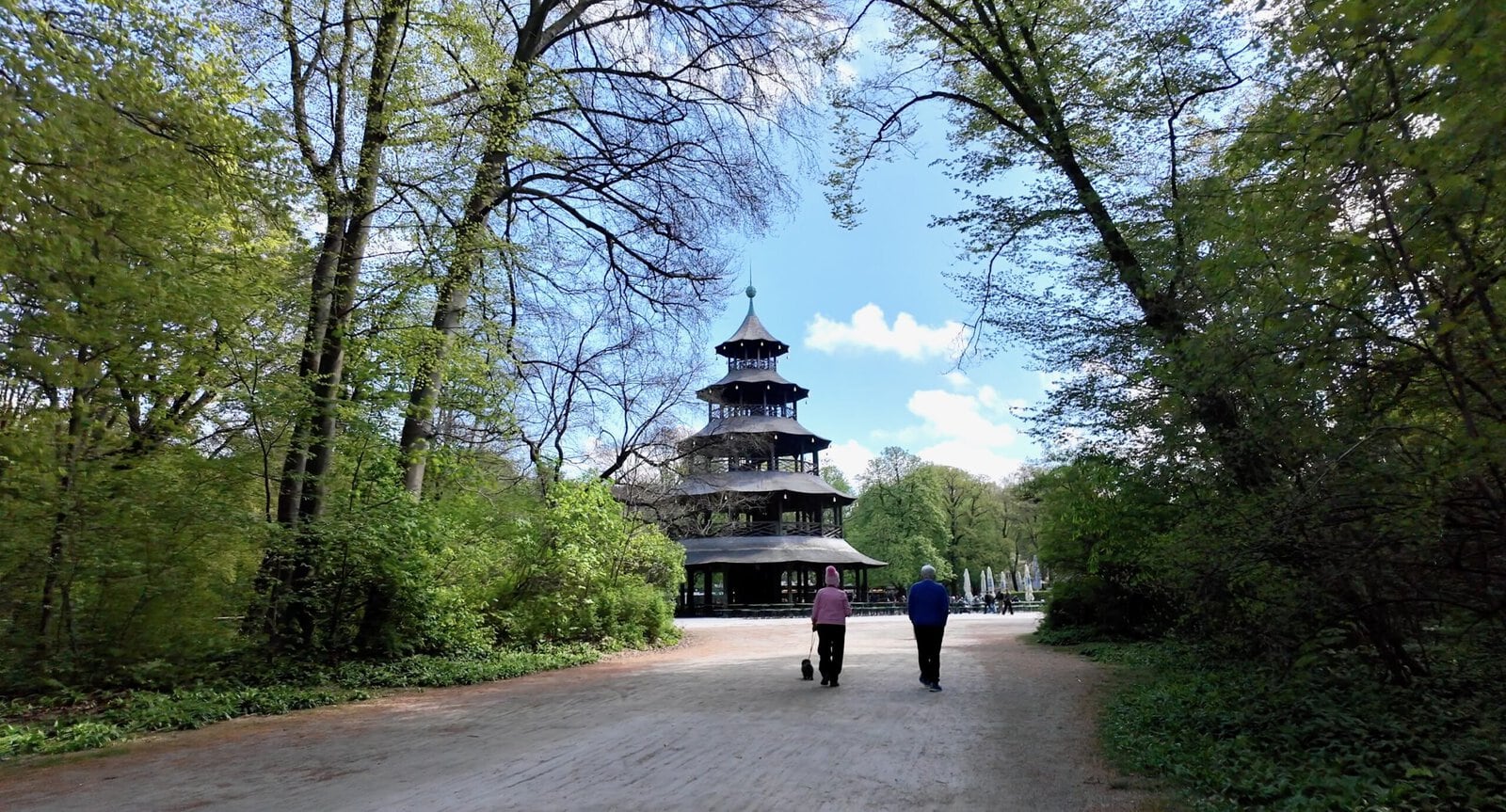
The most unusual thing about the layout is the Englischer Garten: a massive park running straight into the city. Not at the edge — right in the middle of everything. North of the centre it simply takes over from the streets, and the border between city and park is softer than you expect.
A few neighbourhoods
How the city changes
A few areas give a sense of how Munich shifts as you move through it — you recognise them not by name, but by how they feel. A starting point, not the whole map.
Altstadt — the historic centre. Pedestrian zones open up around Marienplatz, and the crowds can appear suddenly around a corner — then disappear again a few streets later.
Schwabing — a residential neighbourhood north of the centre. Trees overhead, cafés, bicycles, a softer pace.
The Englischer Garten — the park in the middle of everything. Walk far enough in and it almost turns into forest, the city slipping away behind you.
How it feels to walk
Walking Munich: Flat, Wide and Easy Underfoot
Munich is flat, and you feel it straight away — you walk further than you mean to without noticing. Crossings come often and the waits are short; bikes have their own lanes, trams their own tracks, so walking here rarely means negotiating for space. Ten minutes of walking feels like ten minutes — the city doesn’t fight you for them.
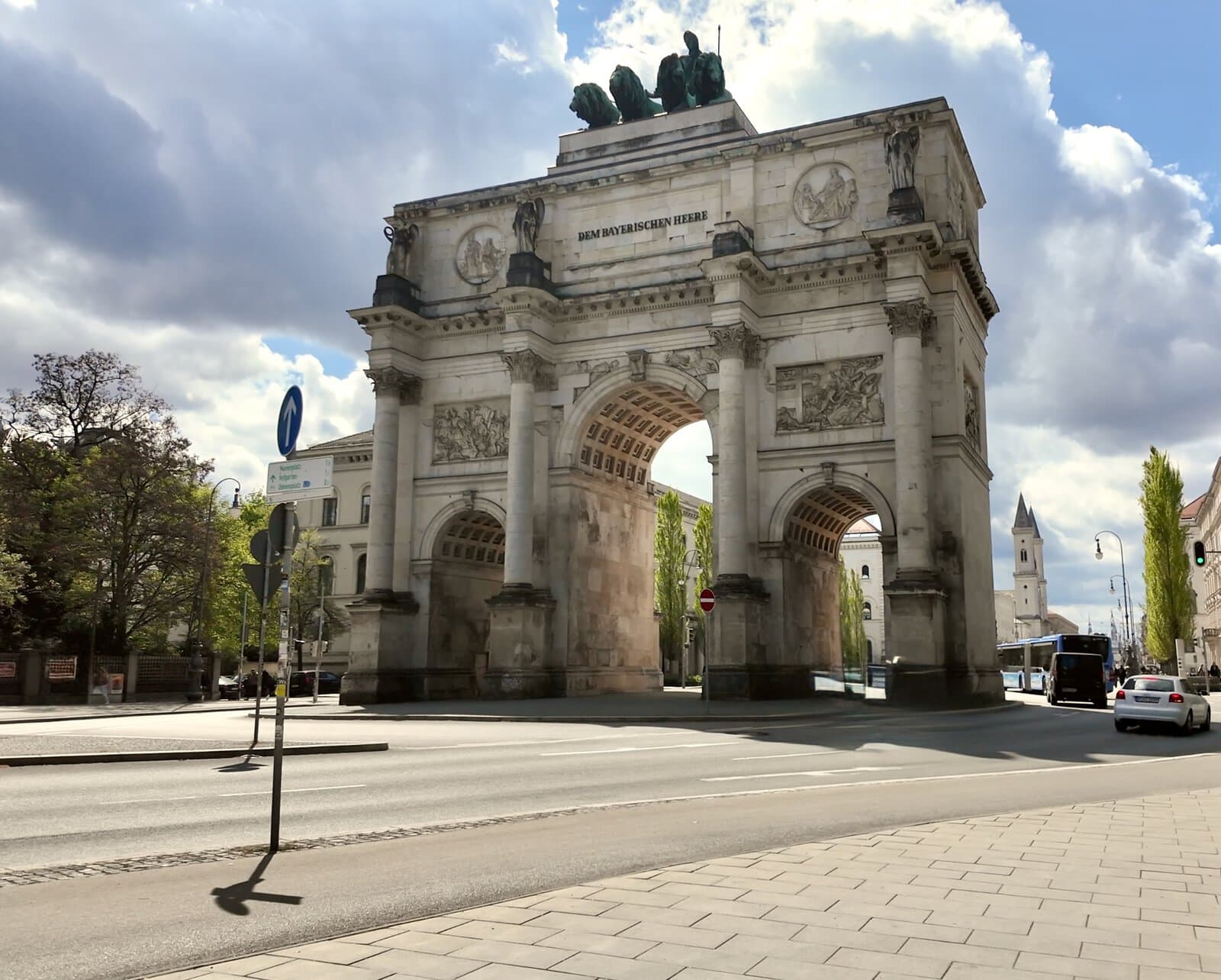
Some streets set your pace for you. Ludwigstraße — the long boulevard running north out of the old centre — is monumental and wide, but at walking pace it keeps you at arm’s length: closed ground floors, windows that start high up. The street opens up again the moment you turn off it. Further north it becomes Leopoldstraße, where the scale drops — terraces, people, movement down at street level.
The quieter pleasures
Where Munich Slows Down
Munich makes room for stopping. Benches along the pavements, green appearing between the buildings — the pauses aren’t tucked away, they’re part of the layout. In Schwabing the pavements widen and the streets grow quieter the further in you go, and at some point the street becomes the park: you cross into the Englischer Garten without quite noticing where.
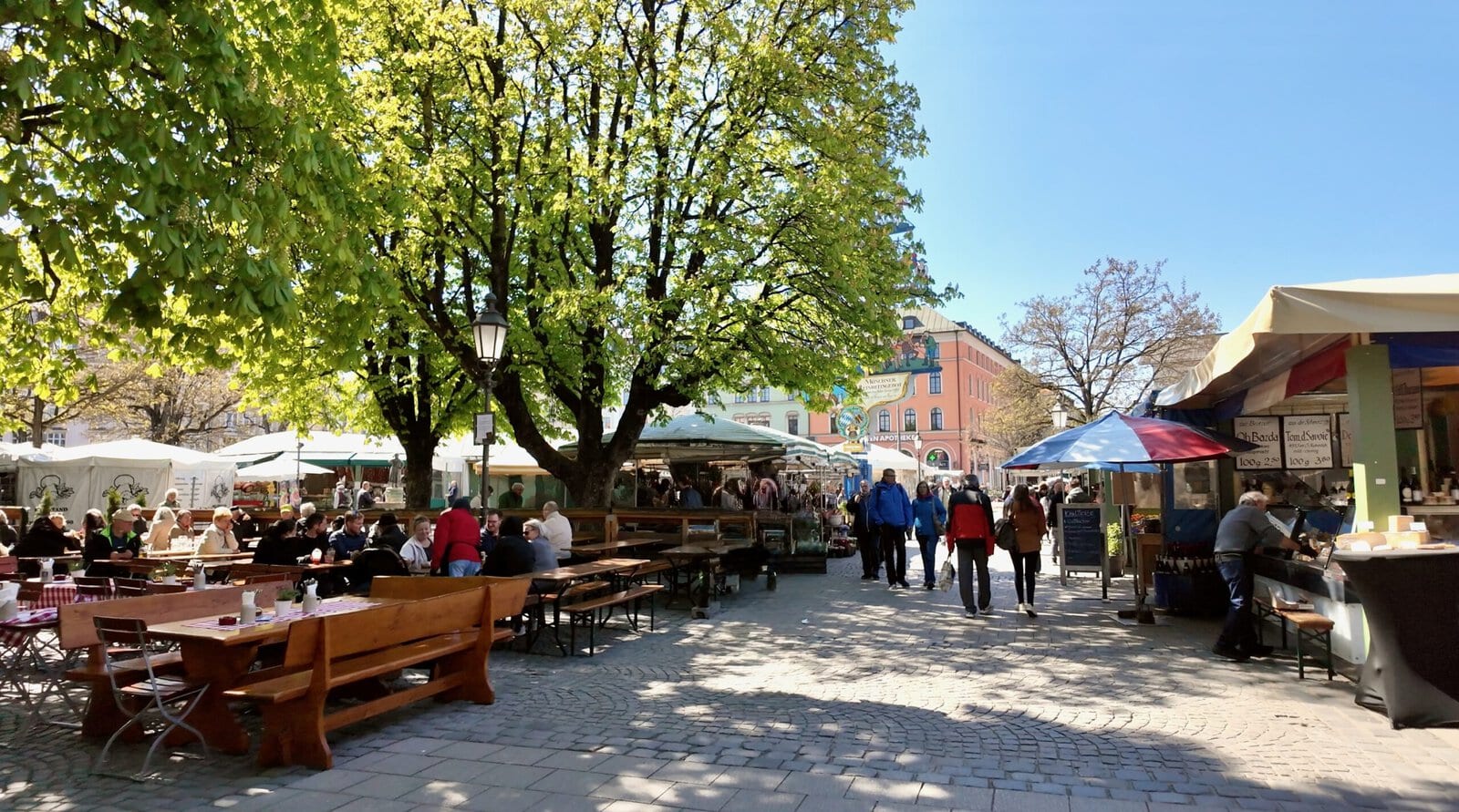
And then the Monopteros — a small domed temple on a rise in the middle of the park. From the slope below it, the city sits there in the distance — towers and rooftops, held back — and people settle on the grass without making much of it. That’s the pattern across the city: you don’t go looking for a place to stop. You drift into one. And there’s the other side of Munich too — the beer gardens, the long tables, strangers sharing time and space. It works, and yes, it’s wonderfully Bavarian.
The Travel Without Chaos Index
How Munich scores
Three dimensions, each out of five — not a ranking, just an honest look at what the city feels like when you slow down.
High. The city is flat, easy to read, and easy to move through. The distances are real, and some routes don’t give much back at street level — but turn off the main boulevard, and that pays off immediately.
Present and genuine, but concentrated rather than scattered. The market in the centre, the beer gardens, the streets to the east and Schwabing — the streets themselves are orderly, and the life gathers in specific places.
More than the density might suggest. Schwabing and the Englischer Garten run into each other gradually, and the park doesn’t feel separate from the city — it feels like where the city goes when it slows down.
On foot
A few places worth knowing
Not sights to tick off — a few suggestions for experiencing each side of Munich on foot. How it feels to walk, where the street life gathers, and where the city lets you stop. It’s how the video moves through the city.
Ludwigstraße north from Odeonsplatz all the way to Münchner Freiheit — monumental and easy underfoot, opening up as the scale drops towards Schwabing. East from Marienplatz towards the Isartor, then wandering the streets around it — busier and lower, a city that’s been used for a long time. And the Isar down by the bridges — trees, water, the city stepping back from itself.
Viktualienmarkt — the open-air market in the centre, one of the few places where people actually stop. A few streets south, around Gärtnerplatz — café terraces and small shops at a neighbourhood pace. And Münchner Freiheit in Schwabing — a meeting point more than a destination, the everyday Munich between transport and cafés.
The Englischer Garten by the Eisbach — a pause with something happening in it, surfers on the wave and people stopping to watch. Wiener Platz to the east — a small neighbourhood square with market stalls and benches, human in scale. And the Hofgarten by Odeonsplatz — a walled garden where the pace drops the moment you step in.
This is how the video walks Munich — the full route is in the film.
What we recommend
Don’t miss these
You’ll come across plenty as you explore. These are the ones we recommend making time for.
Altstadt
The Residenz — the former royal palace of the Bavarian monarchs, and one of the largest city palaces in Europe. It grew over four centuries, wing by wing, so the rooms shift from stark medieval stone to gilded Rococo halls within a few steps of each other. The Antiquarium — a barrel-vaulted hall over sixty metres long, built to display the Wittelsbachs’ collection of antique busts — is worth the ticket on its own. Most visitors walk past the entrance on their way to Odeonsplatz without realising how far back the building runs behind that one façade. Skip the line at the Residenz and Hofgarten →
Marienplatz & the Glockenspiel — the central square and the New Town Hall, with the famous chiming figures above it. Its neo-Gothic front looks centuries older than it is — most of it was built in the late 1800s — and the square below fills and empties in waves through the day. Tour the historic town hall →
Frauenkirche — the twin onion domes that anchor the skyline from half the city. The towers are kept deliberately close in height to the old city gates, a centuries-old rule that still keeps Munich’s centre from feeling overbuilt.
Englischer Garten
The Eisbach wave — a standing wave in a narrow branch of the Isar, right at the edge of the Englischer Garten, where surfers queue year-round to ride it — snow on the bank in winter included. It’s a strange thing to come across on foot: you hear the crowd before you see the water, and then there’s a line of wetsuited surfers taking turns on a wave that never moves downstream. Ten minutes of watching usually turns into twenty.
The Hofgarten — the formal walled garden beside Odeonsplatz. Gravel paths, clipped hedges, a small domed pavilion at the centre — it’s the calmest few minutes you’ll find this close to the old town.
Deutsches Museum — the great science and technology museum on its island in the Isar. One of the largest of its kind in the world, with entire floors given over to mining, aviation and early computing — easy to lose an afternoon in without meaning to. Get tickets →
Beyond the centre
Nymphenburg Palace — the Wittelsbachs’ baroque summer residence, west of the centre, with a canal running dead straight from the front steps out through the park behind it. The Gallery of Beauties inside — 36 portraits King Ludwig I commissioned of women he considered the most beautiful in Munich, regardless of class — is a small, odd, very human detour from the state rooms around it. The grounds alone are large enough to lose the crowds within a few minutes of the entrance. Get tickets to Nymphenburg →
Olympiapark — the 1972 Olympic grounds, with the tent roof and the tower views. The tent-like roof was radical for its time and still looks like it — a huge, deliberately irregular canopy stretched over the stadium and swimming hall below.
BMW Welt & Museum — the futuristic showroom and museum beside the Olympiapark. Worth a look even without an interest in cars: the building itself, with its double-cone roof and cars suspended overhead, is as much the point as what’s parked inside.
The Residenz, Nymphenburg Palace and Deutsches Museum need a ticket. Everything else — the squares, the gardens, the wave — you’ll just walk into.
Short on time? Do two: the Residenz for the history, the Eisbach wave for the strangest five minutes in the city. Everything else you’ll probably stumble into anyway.
Where to stay
Three hotels, all worth the stay
Where you stay shapes how a city feels. For Munich we stayed in three hotels a few minutes apart — all near the station, and all worth recommending. Same corner of the city, three different versions of it.
Munich is where the trip down to the Adriatic begins — the full route is coming soon.