Just passing through
Vienna
Grand and monumental — with the everyday running right alongside it.
Vienna’s old centre sits inside a boulevard that used to be a city wall — cross the Ringstraße and the whole feel of the city changes. Inside it: narrow lanes, grand façades, a pedestrian core where everyone eventually passes through. And running right alongside all that grandeur is something more ordinary — cafés where people sit for hours, benches on streets that aren’t parks, a city that hasn’t tidied away its everyday life to make room for the monuments.
The lay of the land
How the City Is Built
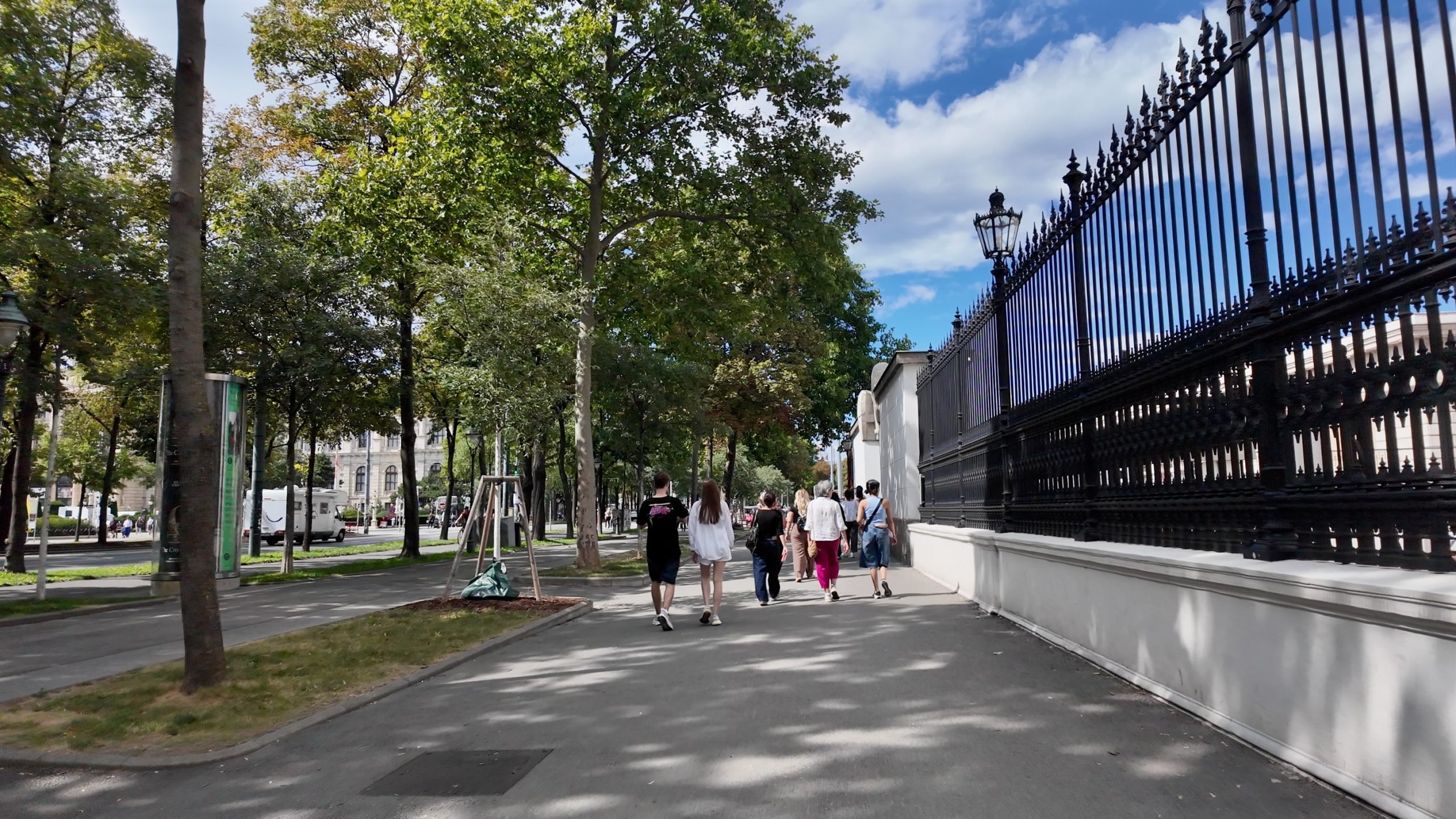
There’s an old centre, and then the Ring — a broad boulevard that circles it completely, trees and trams and monuments along its length — and you feel the city change the moment you cross it. Inside the Ring, the Innere Stadt is a pedestrian core of narrow lanes opening into squares, where the whole city seems to pass through at some point in the day.
Just beyond the museums, Neubau turns more everyday — smaller streets, shops and restaurants set closer together, less dressed up than the centre. Three areas, in other words, and each one reads differently the moment you’re standing in it.
A few neighbourhoods
How the City Changes
A few areas give a sense of how Vienna shifts as you move through it — you recognise them not by name, but by how they feel. A starting point, not the whole map.
Innere Stadt — the old centre inside the Ring. Narrow lanes open into squares, and a pedestrian core carries the whole city through at some point in the day.
The Ringstraße — the boulevard itself, more landmark than neighbourhood. Trees, trams, and a run of grand 19th-century buildings marking the border between the old city and everything beyond it.
Neubau — just past the museums. Smaller streets, shops and restaurants closer together, and a pace that’s more everyday than dressed-up.

How it feels to walk
Where Vienna Walks Easily, and Where It Doesn’t
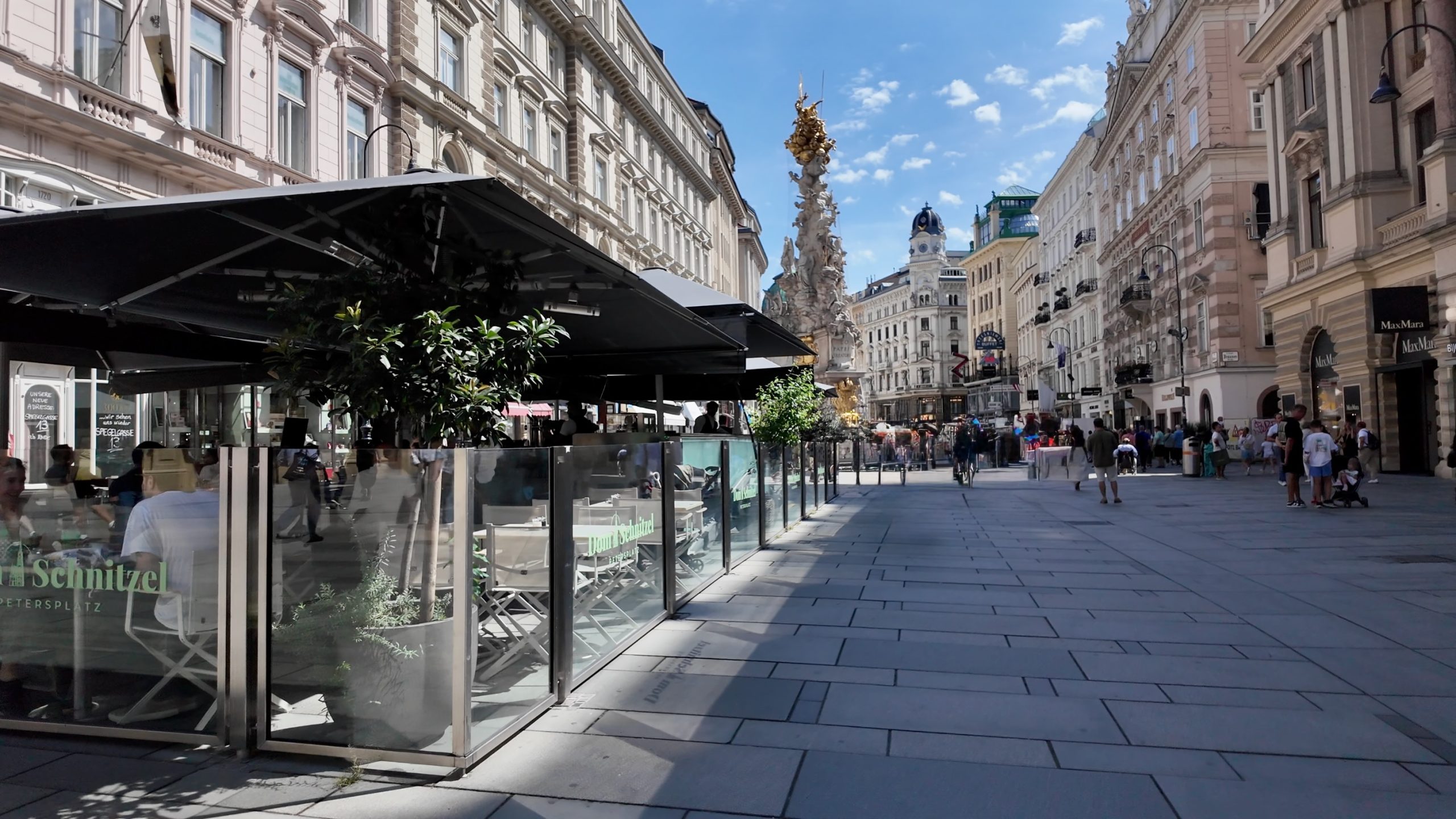
The centre is made for walking, and you feel it immediately. Traffic never fully disappears — it’s part of the picture almost everywhere in Vienna — but inside the Innere Stadt it stays mostly at the edges, and the streets belong to people more than to cars. Walk Graben or Kohlmarkt and you’ve got the whole old town in one stretch: stone underfoot, façades on both sides, no cars in sight. The lanes off the main streets keep connecting, so cutting through the old town in almost any direction comes easily.
Step past the centre, though, and the boulevards widen — more room to move, but the traffic that eased off near the centre comes right back with it. Vienna’s junctions seem to run on their own timing: lights, trams, turning traffic, and what looks like a short walk on the map can mean standing at the curb far longer than planned. The side streets are never more than a turn away — they won’t save you a crossing, but they’ll get you out of the crowd.
The quieter pleasures
Vienna’s Benches Aren’t Just in the Parks
Vienna is one of the most bench-dense cities on this channel so far — places to sit turn up on ordinary streets, not only inside parks. The parks take it further still: gates, gravel paths, plenty of benches. At the Volksgarten, roses and fountains sit with the Hofburg on one side, and the sound of the Ring drops away the moment you step through the gate.
It isn’t really about one park, either. The same basic setup repeats — a bench, some shade, somewhere to slow down — park after park, and not everyone there is looking for quiet. Some of these spaces feel genuinely social, benches full of conversation as much as solitude.
The Travel Without Chaos Index
How Vienna Scores
Three dimensions, each out of five — not a ranking, just an honest look at what the city feels like when you slow down.
High, but not without friction. The Innere Stadt is flat, compact and easy to cross — walk Graben or Kohlmarkt and you’ve got the whole old town in one stretch. Step past the centre, though, and the crossings take real patience; Vienna’s junctions run on their own timing, and a short walk on the map can mean a long wait at the curb. Salzburg, Trieste and Riga land on the same score — worth comparing if you’re weighing similar cities.
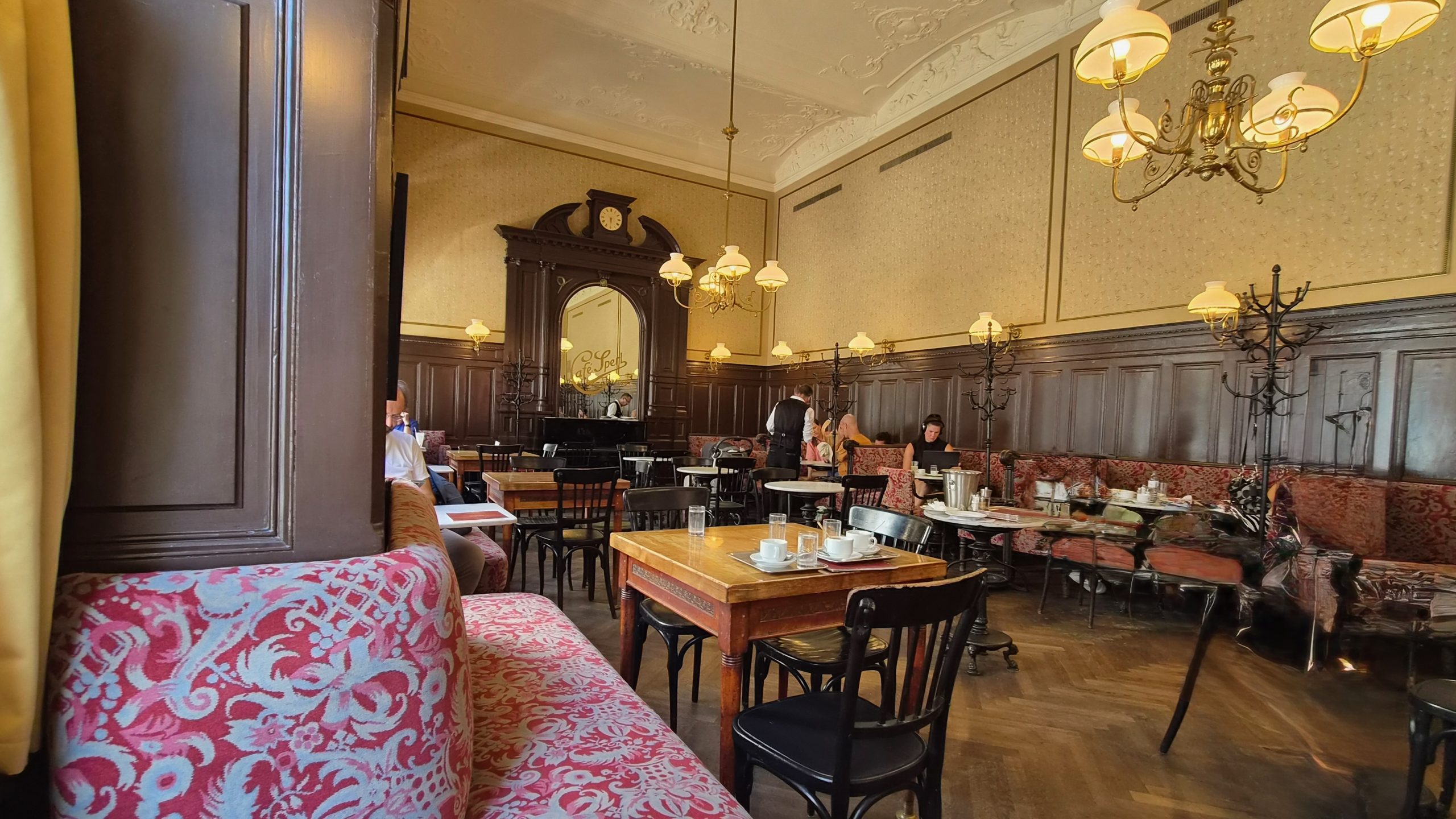
Generous, but concentrated at the tables rather than out on the pavement. Vienna’s café culture keeps people sitting for hours — order one coffee and stay as long as you like. The Naschmarkt is the exception, a long open-air market where the street itself carries the crowd. Riga and Vilnius sit at the same level — worth a look if you’re comparing the two.
Exceptional. Benches line the ordinary streets, not just the parks — and the parks take it further still, with gates, gravel paths and roses at the Volksgarten. The same idea repeats across the city: a bench, some shade, somewhere to slow down. Salzburg, Trieste, Vilnius and Munich all score the same here — worth comparing if pausing well matters to your trip.
On foot
A few places worth knowing
Not sights to tick off — a few suggestions for experiencing each side of Vienna on foot. How it feels to walk, where the street life gathers, and where the city lets you stop. It’s how the video moves through the city.
The Ringstraße between Parkring and the MuseumsQuartier — trees, trams, an easy stretch to walk. Mariahilfer Strasse, wide and open, more room than a typical shopping street. And Praterstrasse, heading out toward the Prater — restaurants and small shops most of the way, right up to the park gates.
The Naschmarkt, the long open-air market southwest of the centre. Neubaugasse, between Mariahilfer Strasse and Burggasse, small shops and restaurants right up against the pavement. And Ballgasse and Blumenstockgasse, tucked in behind Kärntner Straße — small shops and places to eat packed close together, real street life once you turn the corner.
The Volksgarten by the Hofburg, a walled rose garden where the pace drops at the gate. The courtyards of the MuseumsQuartier, a formal space turned into a living room. And Café Sperl, a Viennese coffeehouse near the Naschmarkt in Mariahilf, all parquet floors and marble tables. You order something, you stay, and nobody expects you to move on.
This is how the video walks Vienna — the full route is in the film.
What we recommend
Don’t miss these
You’ll come across plenty as you explore. These are the ones we recommend making time for.
Innere Stadt
St. Stephen’s Cathedral (Stephansdom) — the Gothic cathedral at the dead centre of the city, its roof laid out in a diamond pattern of glazed tiles that becomes the city’s most recognisable image from above. The south tower, nicknamed “Steffl,” climbs a tight spiral to a platform with the whole Innere Stadt spread out below. [VERIFY — unconfirmed comparison] The climb is said to run steeper than St Peter’s in Riga and easier than the spiral stairs of St Olaf’s in Tallinn — somewhere in between, but the view over the rooftops rewards it either way. Below ground, the catacombs hold centuries of Habsburg history, including a chamber most visitors don’t expect until they’re standing in front of it.
The Hofburg — the former imperial palace, now home to the Austrian president’s offices, several museums and the Spanish Riding School under one sprawling roof. Its wings were added over six centuries, so no two courtyards quite match.
The Spanish Riding School — the world’s oldest institution still practising classical dressage, with white Lipizzaner stallions trained inside the Hofburg’s baroque winter riding hall.
The Ringstraße
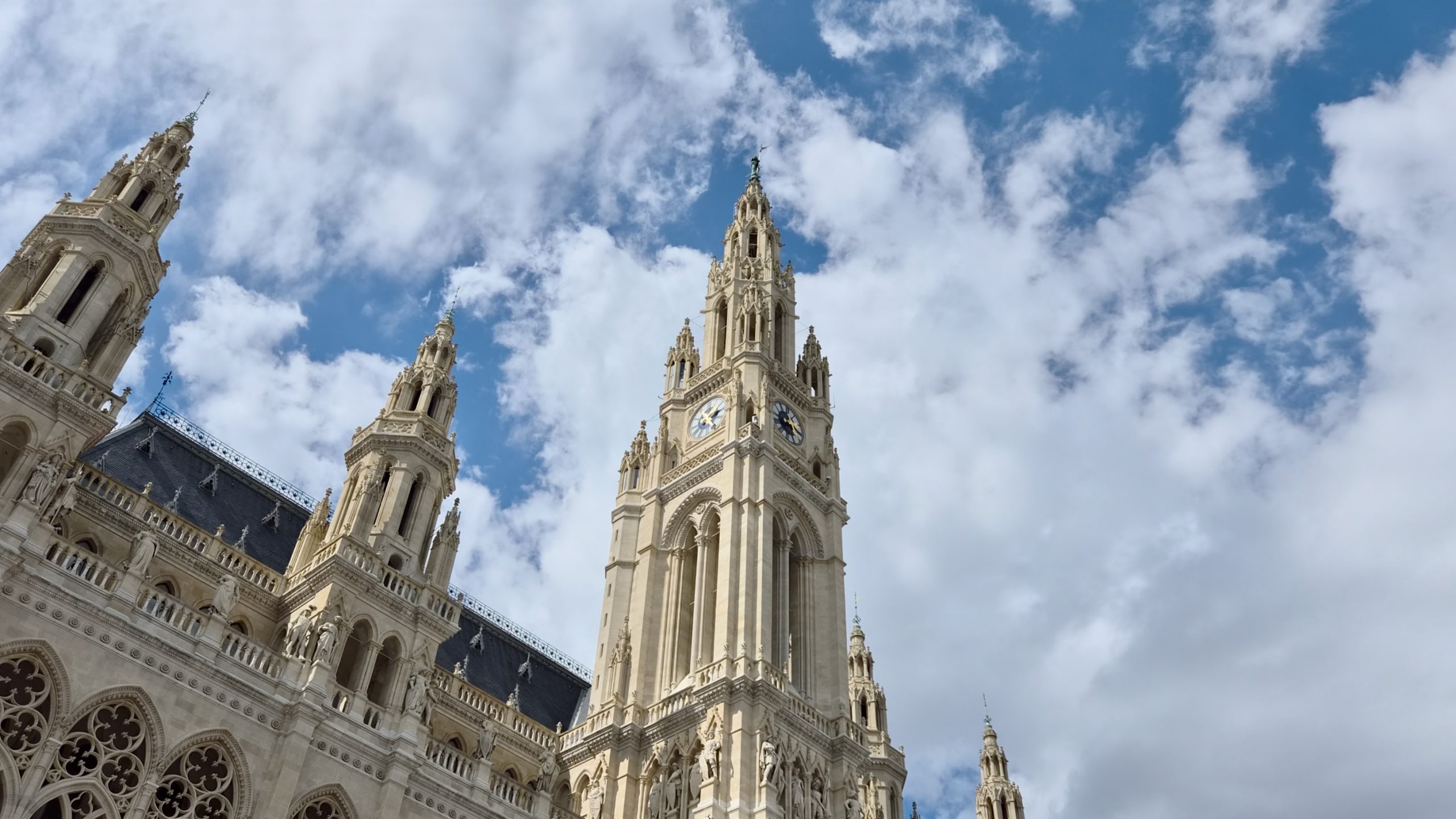
The Rathaus — Vienna’s neo-Gothic city hall, its central tower rising over a hundred metres above a square that turns over to markets and open-air screenings through much of the year. The building was completed in 1883 as one of the grand set-pieces of the new Ringstraße, its spires visible from deep inside the surrounding park. At night the façade is lit, and right at the top of the tower stands the Rathausmann — a knight in armour modelled on Emperor Maximilian I, and one of the city’s own symbols.
The Vienna State Opera — one of the world’s busiest opera houses, staging a different production most nights of the season. Standing-room tickets go on sale a few hours before curtain for only a few euros, so anyone willing to queue can watch a world-class performance from the back of the house.
The Kunsthistorisches Museum — the Habsburgs’ art collection, housed in a palace built specifically to display it, with paintings by Bruegel, Vermeer and Titian in galleries nearly as ornate as the frames.
Beyond the centre
Schönbrunn Palace — the Habsburgs’ summer residence west of the centre, with well over a thousand rooms behind its pale yellow façade and formal gardens running straight up the hill to the Gloriette. Wander far enough into the grounds and the crowds thin out fast — the maze, the palm house and the zoo, the oldest continuously operating one in the world, each pull visitors off in different directions. From the Gloriette terrace, the whole palace and its gardens line up below in a single view worth the climb.
The Belvedere — two baroque palaces linked by sloping gardens, home to Klimt’s The Kiss and the largest collection of his work anywhere.
The Prater — Vienna’s public park and amusement grounds, where the Wiener Riesenrad, a giant Ferris wheel dating to 1897, still turns slowly over the treetops.
Schönbrunn Palace, the Hofburg’s state apartments and the Belvedere need a ticket. Everything else — the squares, the markets, the parks — you’ll just walk into.
Short on time? Do two: Stephansdom for the climb and the view, Schönbrunn for the grandest afternoon in the city. Everything else you’ll probably stumble into anyway.
Where to stay
Three Hotels, All Worth the Stay
Where you stay shapes how a city feels. For Vienna we stayed in three hotels across different parts of the centre — all worth recommending, each a different version of the city.
Vienna is one of three cities on the Three Capitals on the Danube trip, continuing on to Bratislava and Budapest — the full route is coming soon.